Two Birds
RaketspelWord
4.2190.00 Reviews
- Version
- 2.4.1
- Installs
- 100.00K
- Age Rating
- Everyone
Screenshots
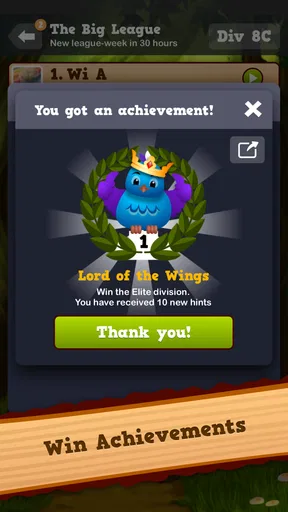
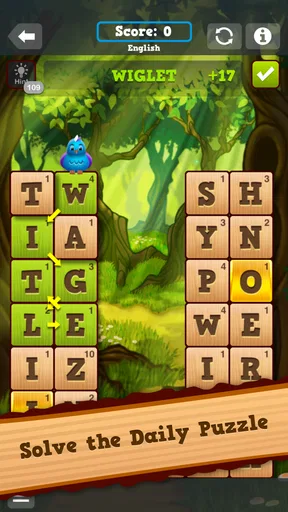
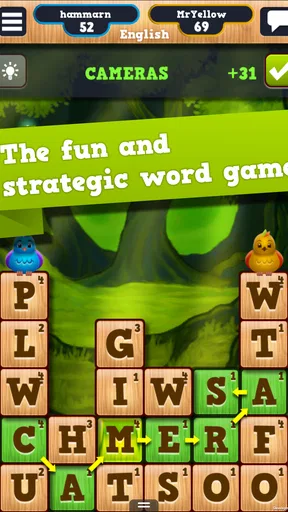
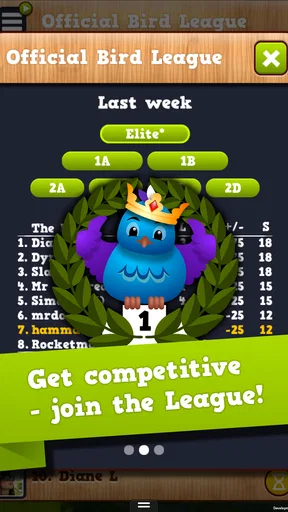
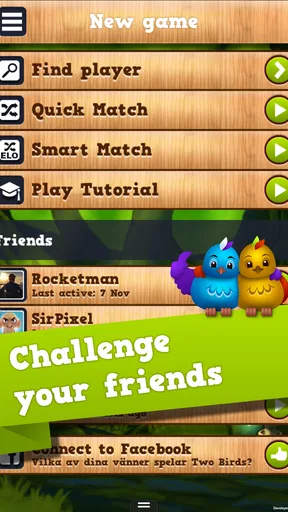
Our Review of Two Birds
 Analysis by Appyee
Two Birds is the kind of word game I can open without preparing for a major time commitment. It sits in the multiplayer word-game space, but its appeal is not limited to making words quickly. The experience depends on how well I read the board, judge risk, and adapt when luck gives me an awkward set of possibilities. That combination makes each round feel more active than a simple vocabulary test.
My first impression was that this is a game built around a clear, approachable idea: words are the main tool, but skill and chance constantly push against each other. That balance matters. If every result depended only on vocabulary, experienced players could make newcomers feel helpless. If luck controlled everything, careful play would not feel rewarding. Two Birds works best in the middle, where a strong word can help but a thoughtful decision about when to use it can matter just as much.
The game is free to download, and its Everyone content rating makes it easy to recommend for casual family play or a quick match between friends. Raketspel has kept it available for years, with a release on March 4, 2015, and the current version is 2.4.1. It supports devices running Android 7.0 or later. Those details make it feel like a practical choice for people using an older compatible phone rather than a game aimed only at the newest hardware.
A word game with a distinct playable mood
What separates Two Birds from many ordinary word puzzles is the way its presentation supports the act of playing rather than competing with it. The title suggests a light, characterful identity, and the overall impression is more inviting than severe. I do not approach a round as if I am sitting an exam. That softer mood is useful because word games can become tiring when every turn feels like a demand to perform.
The setting is not merely decoration around a word grid. It gives the game a recognizable personality, which helps the experience feel like its own product instead of another interchangeable letter challenge. I found that especially helpful during short sessions. When I return after a break, the visual identity gives me an immediate sense of where I am, while the familiar rules let me start playing without a long tutorial or complicated setup.
Art direction also affects how I judge mistakes. In a stripped-down word board, missing an opportunity can feel harsh because the screen offers little emotional distance from the result. Here, the lighter presentation makes a poor turn easier to accept. That does not remove the competitive tension, but it keeps the mood from becoming unpleasant when the letters are unkind or another player finds a better option.
There is a useful distinction between a game that looks cheerful and one that actually feels coherent. Two Birds benefits when its visual language, word-focused mechanics, and relaxed pacing point in the same direction. I never felt that the presentation was trying to transform the game into an action title. Instead, it frames the match as a friendly contest with enough uncertainty to keep me thinking.
How the visual language supports decisions
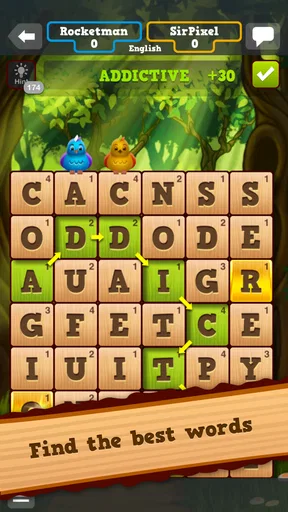
The most important visual job in a word game is clarity. I need to understand the available letters, the current state of the match, and the consequence of a possible move without hunting through the interface. Two Birds is strongest when I can focus on the board and the word in front of me rather than on menus or unnecessary visual noise.
That clarity changes the way I play. I can begin with obvious combinations, then look for less direct options when the first idea is not worthwhile. I also pay attention to whether a move is valuable now or whether keeping a useful possibility for a later turn is smarter. The interface does not make that judgment for me, and that is a good thing: the visual presentation stays readable while the strategic work remains mine.
One of my favorite practical habits is to pause before committing an acceptable word. In a fast puzzle, I might automatically choose the first valid answer. In this game, that can be a mistake. I check whether the move improves my position, uses an important letter too early, or gives the opponent an easier response. That small pause is a concrete way to get more from the game without needing advanced vocabulary.
Players who prefer minimalist word apps may find the character and setting unnecessary. I understand that preference. If the only goal is to practice spelling or solve a daily puzzle in silence, a bare interface may be more efficient. Two Birds is better suited to someone who wants word play to have a little personality and a social, match-based frame.
Sound, pauses, and the rhythm of a match
Sound is easy to overlook in a word game, but it helps determine whether a round feels calm, tense, or mechanical. Two Birds uses its presentation to create a gentle rhythm around each decision. The important point is not that audio turns a word into an action scene; it is that feedback can make a move feel complete and help separate one turn from the next.
I appreciate games that allow me to settle into a repeatable cadence: inspect the board, form a candidate, reconsider it, commit, and wait for the next change. Two Birds fits that pattern. Its pacing gives me room to think, but it does not feel like the game is constantly stopping to explain itself. That makes it comfortable for a short break, especially when I want something more engaging than scrolling but less demanding than a full strategy game.
The same rhythm can become a limitation for players who want immediate action. This is not a word game I would choose when I am looking for rapid reflexes, dramatic effects, or a constant stream of new events. Its tension comes from anticipation and decision-making. If that sounds slow to you, the problem is probably not the quality of the pacing; it is that the game is asking for a different kind of attention.
There is also a practical benefit to this measured tempo. I can play while waiting for an appointment or during a quiet commute without needing to remember a large story or manage a long campaign. A realistic use case is a few rounds with a friend in the evening: one person can think carefully, the other can respond later, and the match still feels connected rather than like a disposable one-minute puzzle.
That flexibility makes it more social than many single-player alternatives. A daily word puzzle gives me a personal challenge, while a traditional crossword gives me a slower, more solitary task. Two Birds adds the pressure of another player’s decisions. I have to consider not only whether I can create a word, but also how my choice changes the contest. That extra layer is the main reason I would recommend it over a basic word generator or spelling exercise.
Where skill and luck meet
The game’s central appeal comes from the relationship between vocabulary, timing, and uncertainty. I can improve by learning common word patterns and by becoming more disciplined about my choices, but I cannot control every situation. That is healthy for a multiplayer game. A newer player can still have a chance, while a more experienced player has meaningful ways to reduce bad outcomes.
My most useful adjustment was to stop treating every turn as a hunt for the biggest-looking word. A modest move can be better if it preserves flexibility or avoids giving away an easy opportunity. This is one of the less obvious lessons the game offers: word knowledge helps, but board awareness and restraint can matter just as much. Someone with a smaller vocabulary can compete more effectively by making fewer careless commitments.
Luck is still part of the experience, and that will not suit everyone. Losing after making sensible choices can feel frustrating, particularly if I am expecting a pure test of skill. I think of each match as a mixture rather than a definitive measurement of ability. Over several games, thoughtful play has more room to show itself, but a single result may not tell the whole story.
That trade-off also makes the game approachable for mixed-skill groups. A family member who does not usually play competitive games can understand the basic objective quickly, while a regular word-game player can look for stronger patterns and better timing. I would not describe it as a deep language-learning tool, though. It can sharpen awareness of word construction and decision-making, but anyone seeking structured lessons, definitions, or a formal study plan should choose a dedicated vocabulary app instead.
What the multiplayer format changes
Playing against another person gives familiar word mechanics a stronger emotional curve. A good move feels better because it affects someone else, and a missed chance is more noticeable because I can imagine the opponent exploiting it. The result is a game that rewards attention without requiring a complex ruleset.
At the same time, multiplayer play means the experience depends on the opponent. A thoughtful match can become a satisfying exchange of ideas, while an uneven match may feel less rewarding. Someone looking for a predictable solo routine should probably choose a crossword, an offline anagram game, or a daily puzzle instead. Two Birds is at its best when the social contest is part of the reason I opened it.
I also recommend deciding in advance how seriously to take the result. With friends, the game works well as a relaxed challenge where conversation matters as much as victory. With highly competitive players, the same mechanics can become more intense. The design supports both moods, but the people involved will shape the experience more than the decorative setting does.
For parents considering it for shared play, the Everyone rating is reassuring as a basic age classification. I would still treat any multiplayer game as a social product and make sure younger players understand how to handle wins, losses, and interactions with others. The game is accessible, but accessibility does not automatically make every competitive session equally comfortable for every child.
Free access and the cost of continuing
Two Birds is free to play, which lowers the barrier to trying it with a friend. I can see whether the word-game loop fits my taste before spending anything. Optional purchases range from ninety-nine cents to sixty-five dollars and fifty cents per item, so I would approach the payment side carefully rather than assuming every player will have the same experience with spending.
My advice is simple: treat purchases as optional extras and decide on a personal limit before buying anything. The free entry is the strongest part of the model for a curious player, while the broad purchase range is something families should discuss if a shared device is involved. A free game can still become expensive when small decisions accumulate, so a little awareness is worthwhile.
This pricing structure also affects who should skip the game. If you strongly prefer a one-time purchase with no optional spending, a paid word puzzle may be a better fit. If you are comfortable trying a free multiplayer game and judging its value through normal play first, Two Birds is easier to recommend. I would not install it expecting a completely separate premium experience unless that is clearly how you prefer to manage mobile games.
Device fit, longevity, and everyday use
The Android requirement of version 7.0 or later gives the game a relatively broad reach among compatible devices. That matters for a word game because its appeal is often tied to convenience: I want to open it on the phone I already use, not replace hardware for a visually demanding experience. Its established release history also suggests a product with a long presence rather than a brand-new experiment.
Its audience reflects that practical role. The game has an average rating of 4.2 from around two thousand ratings, with roughly one hundred ninety written reviews, and it has passed one hundred thousand installs. I read those figures as evidence of a real, active audience rather than a guarantee that every player will enjoy the same style of match. Ratings are useful context, but the important question remains whether I want a social word contest instead of a solitary puzzle.
I would install it for several specific situations: a friendly match during downtime, a light mental warm-up before work, or a shared game with someone who does not want to learn a large rulebook. I would skip it for a long flight without reliable interaction if my main goal were a fully self-contained offline pastime, or for a serious language course where progress needs to be measured and structured.
Compared with Scrabble-style games, Two Birds feels less like a formal board-game recreation and more like a compact mobile contest shaped around its own identity. Compared with Wordle-like daily puzzles, it offers more replay through opposition and less emphasis on a single communal answer. Compared with crossword apps, it asks for faster adaptation and less patient clue solving. None of those alternatives is universally better; they serve different moods, and Two Birds earns its place when I want words plus rivalry.
Small habits that make the game more rewarding
The first habit I recommend is to evaluate the next turn, not only the current score. Before choosing a word, I ask what letters or options I am giving up and whether the move leaves me with a workable follow-up. This is more reliable than chasing the most impressive-looking answer, especially when luck has already made the board awkward.
Second, I try to separate vocabulary problems from decision problems. If I do not know a word, I cannot solve that immediately. But if I know several possible words and still choose poorly, I can improve by slowing down and comparing them. This makes practice more useful because I am learning when to commit, not just memorizing longer words.
Third, I use the relaxed presentation to keep a losing round from becoming a tilt spiral. If a match turns against me, I treat the next move as a fresh decision rather than trying to recover everything at once. The lighter atmosphere helps here, but the discipline still has to come from me. That approach is particularly useful in multiplayer games, where frustration can lead to rushed choices.
Finally, I recommend playing with opponents who enjoy the same level of seriousness. A casual friend may value funny or surprising words, while a competitive player may focus on efficiency. Neither style is wrong, but the game feels more coherent when both people understand whether they are chasing a win or simply sharing a pleasant word challenge.
My atmosphere verdict
Two Birds succeeds because its mood supports its mechanics instead of hiding them. The art direction gives the word contest a friendly identity, the sound and feedback help establish a comfortable rhythm, and the pacing leaves enough space for meaningful choices. Underneath that approachable surface is a game where vocabulary, luck, and strategy keep changing their importance from turn to turn.
I would recommend it to players who enjoy multiplayer word games but want something lighter and more characterful than a strict board-game simulation. It is also a good option for friends or family members with different levels of gaming experience, provided everyone is comfortable with the uncertainty of the format. The game’s free entry and Everyone rating make trying it straightforward, while the optional purchase range is a reason to keep spending deliberate.
I would point dedicated solo puzzle fans toward a crossword or daily word alternative, and I would send serious language learners to an app built around lessons and progress tracking. Two Birds is not trying to replace those experiences. Its strength is narrower and more enjoyable: it turns word knowledge into a social, paced contest where a clever decision can matter even when luck refuses to cooperate.
After spending time with it, I see Two Birds as a welcoming word game with enough strategic friction to avoid feeling disposable. It does not remove the frustrations of multiplayer play, and it will not satisfy anyone demanding complete control over every result. But when I want a compact match with a coherent atmosphere, readable presentation, and room for both skill and chance, it is an easy game to suggest to a friend.
Verdict
Strengths of Two Birds
- Simple controls make it easy to start playing quickly.
- Short levels are convenient for brief gaming sessions.
- Bright visuals give the game a cheerful, approachable style.
- Increasing challenges help maintain interest over time.
- Works well for players who enjoy casual puzzle gameplay.
Limitations of Two Birds
- Some levels may feel repetitive after extended play.
- Progress can become difficult without careful planning.
- Limited variety may reduce long-term replay value.
- Ads may interrupt the experience for free users.
- The game may not appeal to players seeking fast action.
Other Releases by Raketspel
View All
Retro Racing
Racing4.3
Similar Picks in This Category
View All
Word Search - Word Puzzle Game
Bluetile4.8

Word Search Quest - Puzzles
Blackout Lab4.8

CodyCross: Crossword Puzzles
Fanatee, Inc.4.7

Words of Wonders: Crossword
Fugo Games4.9

Wordscapes: Word puzzle game
PeopleFun4.7

Word Search Explorer
PlaySimple Games4.9
Frequently Asked Questions
What is Two Birds, and what can I do with the app?
Two Birds is an app centered around connecting users through shared activities, conversations, or social interaction, depending on the version available in your region. Before downloading, review its current store description because features may change. The app is generally designed to help people discover connections and engage with content in a simple, mobile-friendly environment.
Is Two Birds free to download and use?
Two Birds may be available as a free download, but some features can require in-app purchases, subscriptions, or additional payments. Check the Google Play Store or Apple App Store listing before installing to confirm the current pricing model. Also review subscription terms carefully, including renewal conditions, trial periods, and cancellation instructions, so there are no unexpected charges.
Does Two Birds require an account or personal information?
Depending on the platform version and the features you want to use, Two Birds may require registration with an email address, phone number, or social login. It may also request access to profile details, notifications, location, camera, or contacts. Only provide information you are comfortable sharing, and read the privacy policy to understand how your data is collected and used.
Is Two Birds safe and suitable for all users?
Two Birds should be used with the same caution as any social or communication-focused application. Avoid sharing sensitive personal details, financial information, passwords, or your exact location with other users. Check the app’s age rating and community guidelines before downloading, and use blocking or reporting tools if available. Parents should review the app before allowing younger users to access it.
What devices and permissions are needed to use Two Birds?
Two Birds is intended for supported Android or iOS devices, although compatibility can depend on your operating-system version and available storage. The app may request permissions for notifications, photos, the camera, microphone, location, or contacts, depending on which features you use. You can usually manage these permissions later through your device settings, and denying optional access may limit certain functions.
Play our best games!


